

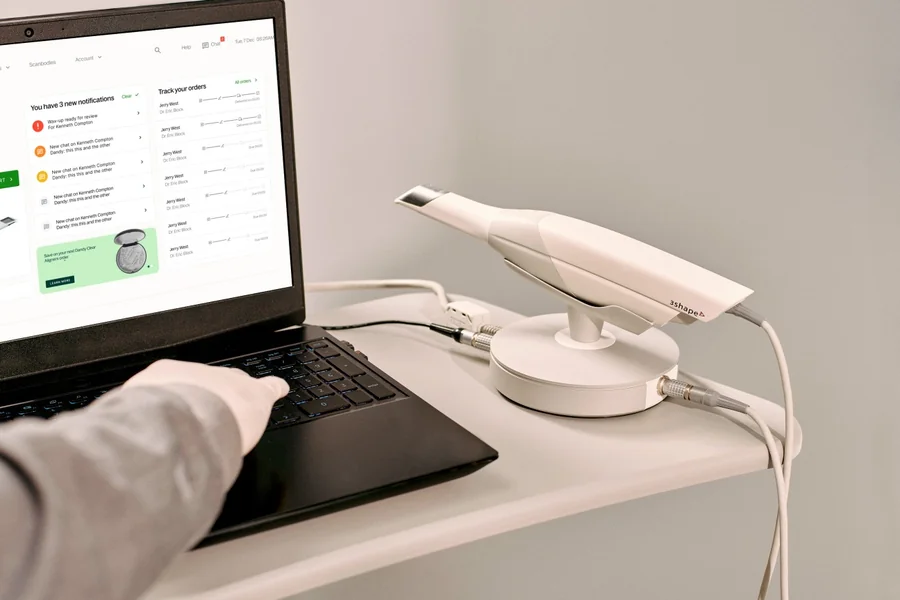
Intraoral scanners have been around long enough to go through multiple “next big thing” cycles. Every year, something new hits the market, claiming to have a better screen, a smaller wand, or a faster processor.
And yet, plenty of dental offices still rely on the trusty TRIOS 3 scanner.
First introduced in March 2015, this intraoral scanner has managed to maintain its foothold in the digital dentistry niche, even with newer models and a growing list of competitors. Dentists who use it tend to keep it because it’s simple and reliable.
If you’re researching an intraoral system or comparing options, it’s worth taking a closer look at why the TRIOS 3 scanner continues to come up in conversation.
What Is the TRIOS 3?
The TRIOS 3 scanner captures digital impressions of the teeth and surrounding soft tissue. The files can be used across a wide range of treatment types, including:
- Crowns and bridges
- Inlays and onlays
- Veneers
- Clear aligners
- Implant planning
- Bite analysis
- Diagnostic records
Once the scan is complete, the file can go straight to a lab, or it can move into an in-house CAD/CAM workflow for milling or 3D printing.
On paper, this capability doesn’t sound wildly different from other scanners on the market. What sets the TRIOS 3 scanner apart is how steady and predictable it remains in a real-world workday.
8 Reasons Why the TRIOS 3 is A Digital Dentistry Staple
It takes more than clever features to find a permanent spot in a dental practice. The TRIOS 3 has earned its reputation through day-to-day reliability, ease of use, and high-quality scans.
1) Accurate Results
Precision is non-negotiable in dentistry. A tiny error can mean a return visit, a remake, or an unhappy patient. The TRIOS 3 offers consistently high trueness and precision, even in complex cases.
The advanced optical system minimizes distortion and stitches images together smoothly, reducing the chance of visual noise or artifacts that could interfere with your restoration design.
Better margins lead to restorations that seat properly with fewer adjustments. Over time, this reduces frustration on both the clinical and lab sides.
2) Better Experience for Patients in the Chair
Most people remember traditional impressions as one of the least pleasant parts of a dental visit. The thick material, odd taste, and feeling of having a full tray in the mouth made it uncomfortable for just about everyone.
With the TRIOS 3, this experience is completely different. There is no tray or messy material. The scanner simply moves over the teeth and captures everything digitally in just a few minutes.
Patients usually say it feels much easier than they expected. The process is quicker, more comfortable, and far less stressful, which helps them feel more relaxed and confident about moving forward with treatment.
3) Powder-Free for a Cleaner, Quicker Workflow
Early-generation scanners often required clinicians to apply a fine layer of powder to the teeth before scanning. It created a mess and sometimes produced uneven results if the coating wasn’t perfect.
The TRIOS 3 does not use powder at all. Dentists can begin scanning the teeth immediately, without any added preparation or materials.
Removing this step shortens each appointment and eliminates a variable that could impact scan clarity. It also keeps the operatory cleaner and more controlled.
4) Real-Time Visualization and Immediate Feedback
One reason many clinicians feel confident working with the TRIOS 3 scanner is the live visual feedback it provides. As the dentist moves the scanner along the arch, a full-color 3D image forms on the screen.
If an area is missed, it’s obvious right away. The section can be rescanned on the spot instead of being discovered later when the patient has already left.
Additionally, the real-time view makes it easier to involve the patient in the process. Many enjoy seeing their teeth on the screen, and the visual element makes treatment discussions clearer and more effective.
5) Smooth Integration with Digital Workflows
A scanner cannot work in isolation. It needs to connect with the rest of your digital setup.
The TRIOS 3 can integrate easily with the CAD/CAM systems, design software, in-house milling units, and dental labs you already use. Your files transfer quickly and cleanly, without the headaches of data issues or clunky workarounds.
The connection helps the entire dental workflow run better. The dental office can send cases to the lab faster, complete in-house design and production with fewer steps, and cut down turnaround times. It also makes communication with your lab much clearer and allows for more predictable results.
6) Color Scanning for Better Diagnostics
Some scanners still rely heavily on greyscale imaging. While this can work for capturing form, it does little to highlight subtle changes in surface texture and color.
The TRIOS 3 scanner captures full-color images. The extra layer of visual data helps clinicians identify demineralization, cracks, soft tissue changes, and early signs of wear that may be harder to detect on a monochrome model.
It also supports better shade communication with the lab. Technicians benefit from seeing realistic tissue and tooth color, especially during aesthetic cases where fine details matter.
7) Comfortable, Lightweight Design
Technology is only useful when it does not physically wear down the person using it. Heavy, awkward handpieces can turn even the best scanner into an everyday annoyance.
The TRIOS 3 has a lightweight, well-balanced handpiece that feels natural to hold and easy to control. It moves easily around posterior regions and across lingual and occlusal surfaces without excessive wrist strain.
Roughly one in seven dental healthcare professionals develops carpal tunnel syndrome. Reducing hand and wrist strain supports better focus and more consistent results throughout the day.
8) Future-Ready Without Constant Replacements
Many devices start strong and fade fast as new hardware is released. The TRIOS 3 scanner followed a different path. Regular software updates and ongoing platform improvements helped it stay current without needing to be replaced every couple of years.
Practices that adopted it early have been able to continue using it confidently without feeling left behind each time a new device launches.
This reputation is also why the TRIOS 3 scanner for sale still attracts attention from practices looking for reliable, proven technology rather than the latest untested release.
Not the Newest, Still One of the Best
Digital impression systems come and go. Very few hold their place in the market long enough to be widely adopted, let alone widely trusted. The TRIOS 3 scanner is one of the rare devices that continues to deliver the same level of reliability it did on launch day.
If your practice needs something accurate, comfortable for patients, easy to use, and made to work well with the rest of your digital tools, the TRIOS 3 remains one of the strongest choices available.
